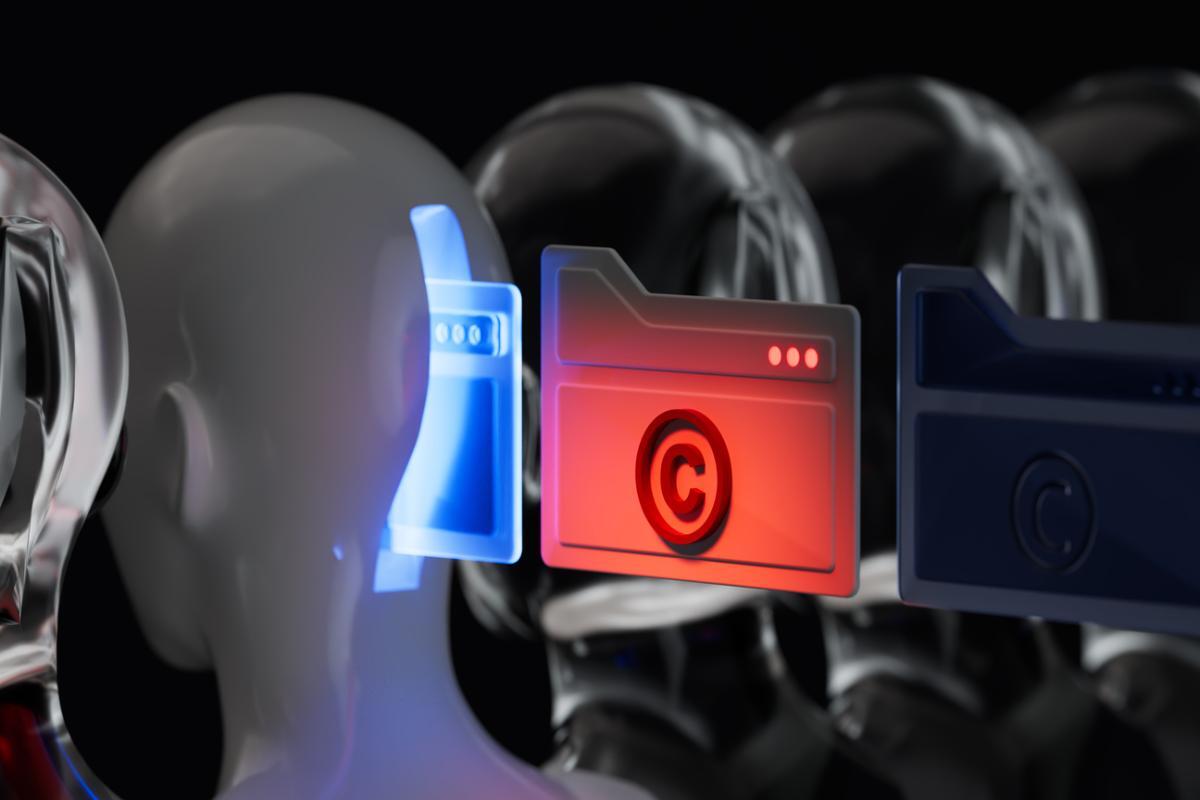
Artificial intelligence (AI) is transforming the way we create art, music, literature, and even software. With tools that can generate entire works at the click of a button, many creators and businesses are asking a critical question: Can AI-generated works be protected under copyright law? The answer is not as straightforward as it may seem.
For artists, entrepreneurs, and companies leveraging AI, understanding the boundaries of copyright law is essential. Whether you’re experimenting with AI to enhance your creative process or relying on it to produce original content, you need to know what rights you may—or may not—have over the finished product. You can contact a Miami copyright attorney at The Lomnitzer Firm P.A. to understand whether copyright law protections are available for your creative works and how to safeguard your intellectual property in this rapidly evolving legal landscape.
Authors of original or independent creative works can protect their works through copyright, a form of intellectual property. A copyright is available for a creative work when its author has “fixed” the work in a tangible form of expression. To “fix” a work, its creator must capture it in a “sufficiently permanent medium” that lasts more than a short period of time.
Various types of creative works can be protected by copyright under U.S. law. These works include literary works, dramatic works, pantomimes and choreographic works, pictorial, graphic, and sculptural works, motion pictures and other audiovisual works, sound recordings, and architectural works.
A copyright is unavailable for some items because they are not creative expressions that fall within the purview of copyright law. These items include names, familiar symbols, ideas, methods, and ingredient lists, among others.
U.S. copyright law is clear that works completely generated by artificial intelligence (AI) are not copyrightable. In 2023, the U.S. District Court for the District of Columbia became the first court to handle a case involving the copyrightability of an AI-generated work. That court affirmed the U.S Copyright Office’s refusal to register a completely autonomous AI-generated image, stating that “copyright law protects only works of human creation,” Thaler v. Perlmutter, 687 F. Supp. 3d 140, 146 (D.D.C. 2023). On appeal, the U.S. Court of Appeals for the District of Columbia Circuit affirmed the lower court’s decision. Thaler v. Perlmutter, No. 23-5233 (D.C. Cir. 2025).
The Office reiterated this principle in January 2025 with the publication of the second portion of its report on Copyright and Artificial Intelligence – Part 2: Copyrightability. The report cites the U.S. Copyright Office Review Board’s final decision affirming the denial of copyright registration for a work generated solely by AI, with no human involvement.
In 2023, the U.S. Copyright Office issued a registration for a comic book containing some AI-generated material. That same year, the Office issued a statement of policy guidance on works containing AI-generated materials. In that statement, the Office reiterated that human authorship is an essential requirement for copyright protection under U.S. law. The statement also advised authors to disclose if a work contains any more than a de minimis amount of AI-generated materials and provide a statement as to the human author’s contribution to the work when seeking a copyright.
In its report on copyrightability referenced above, the Office acknowledged that works are copyrightable to the extent that their human contributions qualify as authorship. The Office recognizes three situations in which a work containing AI has human authorship sufficient to merit copyright protection, as follows:
For instance, under the first situation listed above, authors can copyright works in which they used AI as an initial brainstorming tool. Likewise, authors may use AI to structure or create a preliminary outline of literary works. On the other hand, using simple prompts to generate output is insufficient to confer human authorship to allow copyrightability.
Yes. While U.S. copyright law requires human authorship, creators may seek protection through other means. For example:
The U.S. Copyright Office requires applicants to be transparent. If a work contains more than a minimal amount of AI-generated material, the applicant must:
Failure to disclose AI involvement could result in cancellation of the registration later. Transparency ensures that the copyright covers only the human-authored portions of the work.
Creators can bolster their copyright eligibility by:
As artificial intelligence continues to reshape the creative landscape, the law is still catching up. Questions about authorship, originality, and ownership are at the forefront of debates in courts and among policymakers. If you are exploring AI tools in your business or artistic practice, it’s important to understand how copyright law applies to your situation and what steps you can take to protect your work.
The Lomnitzer Firm P.A. is here to guide you through these complexities and help safeguard your intellectual property. Contact a Fort Lauderdale copyright attorney today to discuss your creative projects and ensure your rights are protected in this evolving digital age. You can call our office at (800) 853-9692 or contact us online.